

Table of Contents
Artificial Intelligence (AI) tools like ChatGPT, Gemini and other AI-powered search platforms are disrupting the role of traditional, website Search Engine Optimization (SEO). For two decades, SEO professionals carried out practices to get Google to rank their site on the first page of the search results. Their goals was to then get clicks into their websites.
These types of searches were "informational," meaning there was some piece of information the user needed, such as a “recipe for apple cake.”
However, now users simply ask their favorite AI platform and get the answers they seek right there. No longer do users examine the search results and click into websites to find their answers.
The ease of AI search has quickly derailed the role of traditional SEO, that of getting traffic to websites. It’s caused many to ask, “Is SEO dead?” The truth of the matter is that SEO is not dead. Specifically, a second form of SEO, Local SEO. The good news for businesses that use it is this: AI tools already rely on it and we contend that if you're engaged in Local SEO practices, you have a better chance of being recommended by AI tools.
Local Search
Local searches are not about information, but more about the user’s "commercial" intent, meaning, they have a need and want to spend money to fix it. They are looking for a specific service in a specific area. The intent is different than informational searches.
Search examples of this type include, "tow truck near me," “plumber near me,” “house cleaning in Loveland, Ohio,” or “CPA in fort Thomas, KY.”
Recognizing there was a “local” need, Google began showing local businesses alongside a local map in the search results in 2007. The local search map dramatically changed how users found local businesses. Today, it is one of the most important sources of leads for local businesses.
Google Business Profile
The cornerstone for showing in local search is a company’s Google Business Profile (GBP). In fact, you must have one if you want to be seen in this section. When a business shows in local search, the information in the four- or five-line description is pulled directly from your GBP.
Local SEO is Different Than Traditional, Website SEO
This area on the search results does require a form of search engine optimization to show here, but not the type that websites need. In fact, this area has very little to do with your website. Instead, it is fueled by information that is strategically seeded across the internet.
What Google is Looking For
In those top three positions next to the local search map, Google wants to show what it believes are the three most credible businesses in the area. Since it is an algorithm, Google relies on information it can find around the internet. Some of that information includes:
- Reviews and star-ratings on your Google Business Profile
- Your business information in directories
- Other review platforms
- Your business website
- Information you place on your Google Business Profile such as photos, hours and contact information.
- Social Media activity
If a business has this information out there, it is deemed credible by Google and has a good chance of showing in the Local Search results.
Local SEO’s job is to post the type of Information Google wants to see, in the places where Google looks for it and repeat that practice on a regular, frequent basis.
Local Search Is Also Proximity-Based
Another key factor in Local Search is distance. Google’s local ranking system considers how close a business is to the person searching. Then it weighs that distance-to-the-user factor against the credibility factors of nearby businesses.
So, if a company has low credibility with Google, it is possible to stand in the lobby of that business and not see them in local search. But you would see other businesses with more credibility, even though they might be several miles away.
What’s This Have To Do With AI?
The previous sections are all background information about local search that needs explained before the next statement can be understood or believed. Here it is: Local Search is not impacted by AI, and in fact, doing Local SEO can actually help AI tools discover your business!
Local SEO Helps AI
While AI can summarize information easily, it still needs reliable sources that list businesses, their services, and their locations.
As the internet exists today, that information largely comes from sources like these:
- Reviews on you Google Business Profile
- Your business information in directories
- Other review platforms
- Your business website
- Information you place on your Google Business Profile
- Social Media activity
Does this list look familiar? It is the exact same list of information that Google wants to see. So, if you’re doing Local SEO practices, that is feeding this information to Google, you’re actually feeding AI platforms the information they are looking for, as well.
AI systems are still relying on the existing internet ecosystem to determine which businesses to mention. If you’re adding information to that ecosystem through Local SEO practices, you have a higher likelihood of being discovered by AI.
The Proof
Signal Digital Marketing does not optimize for AI right now. We search optimize our website and do a great deal of Local SEO. But that has made an impact with a couple of AI tools.
First, let's look at Google's Gemini. We entered this prompt, "What is the best SEO agency on the eastside of Cincinnati, Ohio?" This is the result:
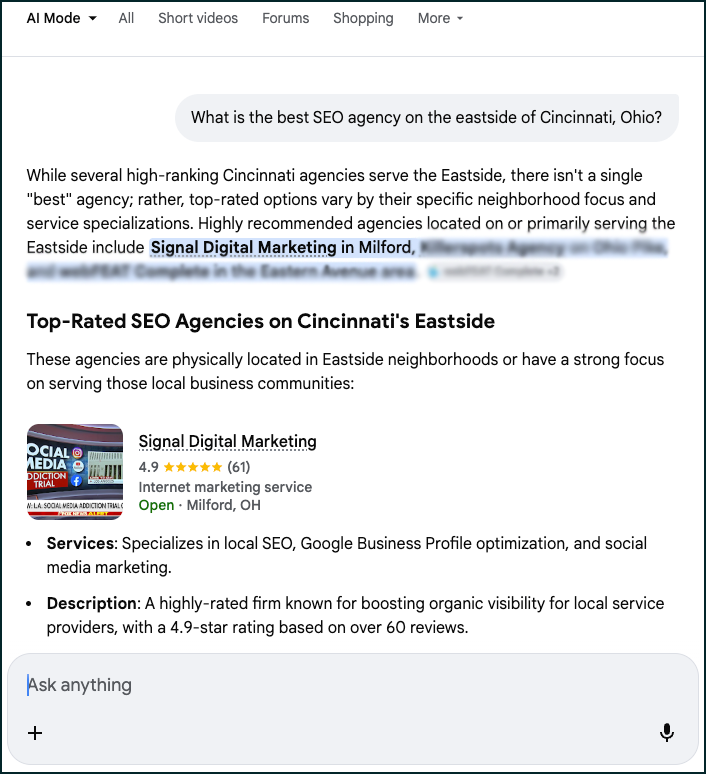
Gemini showed us with two other agencies, but showed us first. The image and four lines of information about our business were pulled directly from our Google Business Profile, put there as part of the Local SEO work we consistently do. That's proof that Google's AI, Gemini, is looking at the results of Local SEO work.
We also tried the same prompt with ChatGPT and here's what we saw:
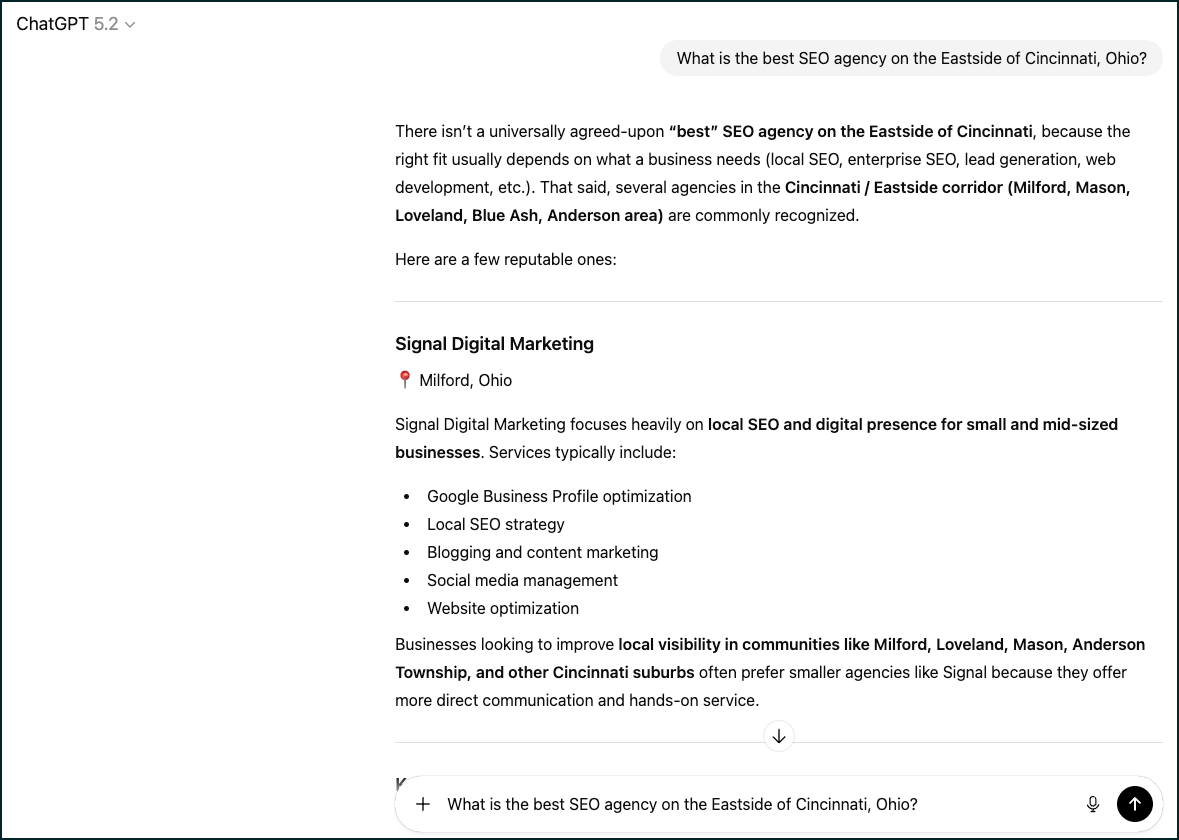
ChatGPT also recommended us first and pulled information from our Google Business Profile to describe us.
By no means are these results meant to be a scientific proof. In fact, the results from various AI tools can change from day-to-day and search-to-search. But what this dose suggest, and we stand by it, is that Local SEO impacts the answers that AI search tools give. As was mentioned earlier, it is the only optimization we do continually.
So if you own a local business and want to be recommended in Google's Local Search and also on AI platforms, then working with a Local SEO and AI agency like Signal Digital Marketing makes sense.
The Future: AI + Local Data
Looking down the road, AI search tools in the future will likely layer their answers on top of existing local data sources. Rather than replacing local search, AI will probably become another way people discover local businesses.
In order to benefit from both Google search and AI-driven discovery, businesses will need to maintain:
- Accurate business listings
- Strong review profiles
- Consistent directory citations
- Clear website information.
Bottom Line
Artificial intelligence is changing how people find information online, but Local SEO remains one of the most resilient areas of digital marketing. Businesses that serve local communities still need strong visibility in Google Maps, strong reviews, and consistent online information. All areas that Local SEO can enhance.
Related Resources
Local Search Rankings: You Need to Get Some Stars
Why It’s So Important to Keep Your Business Info Consistent Online
Why Adding Photos to Your Google Profile Matters
Overwhelmed by AI? Here’s a Simple Breakdown for Small Business Owners from ChatGPT
Should I Use AI to Reply to Reviews?
Getting Help
Do you want to enhance your company’s local search presence? Call us today at 513-237-5530 and we’ll set up a free consultation.
Signal Digital Marketing: Be Found. Be Chosen.